Beyond the Headlines: How Burton’s Ahmadiyya Muslim Community is Rewriting the Narrative Through Service, Not Slogans.
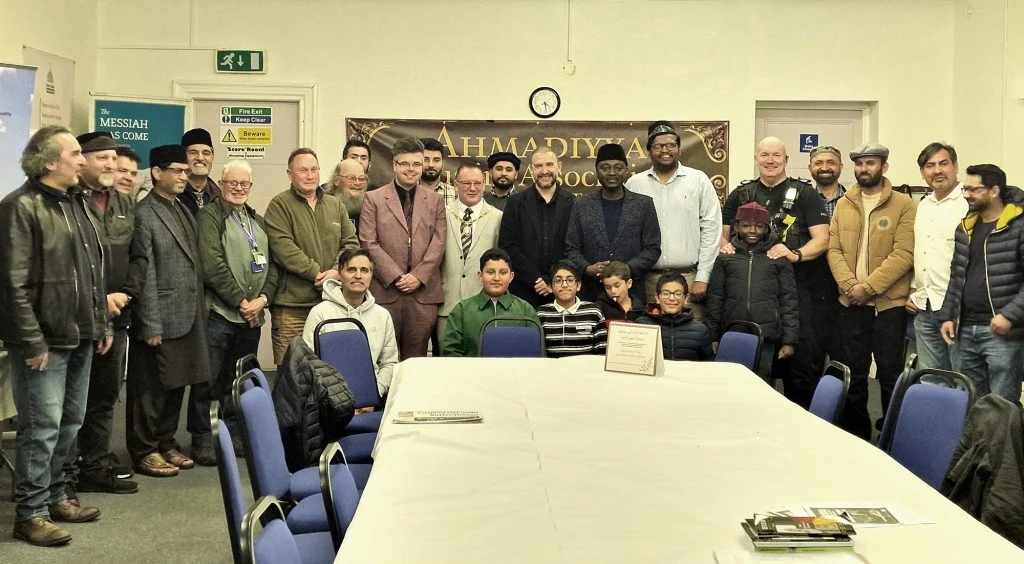
When Jamil Ahmed, Outreach Coordinator for the Burton Ahmadiyya Muslim Community, opened the doors of the Baitus Saboor Mosque for Visit My Mosque Day during Fairtrade Fortnight, he wasn’t just inviting neighbours in for tea and samosas. He was extending an invitation to challenge everything the media has told you about Islam.
Among those who accepted were Branston Mayor and Councillor Andrew Riley, Deputy Mayor Josh Riley, Sergeant Jonathan Moses, John Anderson from Burton Hope, John Ferrie from SARAC, and Lawrence Oates from Fairtrade Fortnight. A cross-section of Burton’s civic and charitable leadership that speaks volumes about the mosque’s role as a genuine community hub.
But this wasn’t a PR exercise. This was Saturday. This is what they do.
A Different Kind of Mosque
The first thing that strikes you when you walk into the mosque is the noise. Children, some as young as six, are running around with the kind of unbridled energy that would have most adults reaching for paracetamol. But the men deep in prayer don’t flinch. There’s no shushing, no stern looks, no attempts to corral the kids into silence. The adults are focused on their prayers, and the children are simply being children in a space that belongs to them as much as anyone else.
There’s a pool table in the corner.
Let that sink in for a moment. A pool table. In a mosque.
Although it’s a mosque, it’s also a community centre. We want to develop that bond with the mosque for the children. Even if it takes them a while to come and pray, at least they come in and build friendships here.
Ibrahim Bonsu, provides the historical context. “The mosque as a community centre isn’t our innovation. We read in history that when Christians visited the Prophet in Medina, he gave them his mosque to pray in. That’s how a mosque should be: a place to remember God, and a place in the community for people to seek peace and sanctuary.”
This isn’t just theory. The Burton mosque regularly offers its space for council surgeries, men’s support groups, and community meetings. “It’s Freedom of conscience,” Bonsu continues.We open our doors to Baitus Saboor Mosque, and welcome everyone. There’s no compulsion in religion. Our duty is to convey the message, and whether individuals accept it is up to them.Knocking on Doors, Breaking Down Walls
Aamir Sikander, Vice President of Burton Ahmadiyya Muslim Community describes their approach to community integration with disarming simplicity. “We opened the mosque doors, and we went round the neighbouring streets, knocked on doors, and said, ‘This is your mosque. Come and have some food with us.’”
But they don’t stop at invitations. “We asked them if there was any help we could give. If you’re elderly, can we come and do your garden? If you can’t get to the shops, can we get your shopping? If you need medicine, we’ll collect it for you.”
The response? Reciprocal kindness. “When we gave out gifts on New Year, we handed samosas to the neighbours,” recalls one community member. “Afterwards, we received cards and chocolate from them in return. It’s good to receive that as well, because while we’re reaching out, the community is recognizing us.”
Even the local pub has become part of this web of mutual support. “We have the local pub here, and although we can’t go to pubs ourselves,” Sikander laughs, “they were raising money for the Cold Cots charity and came to the mosque asking if we could help. Our chef made biryanis, put them in plastic boxes, and we gave them out.
We don’t focus on what we can’t do. We focus on what we can do.
It’s a small story, but it captures something essential. A pub raising money for charity. A mosque that can’t participate in the usual way. But instead of saying no, they find another way. Biryani in plastic boxes. A gesture that says, we’re here, we’re part of this village, and we’ll help however we can.
Ladies First
When it comes time for interviews, Sikander makes it clear who’s going first. “The ladies want to do this separately,” he explains, gesturing towards a partition. “We’ll do ours after.”
He grins. “We do ladies first. Otherwise, there’ll be words at home.”
There’s laughter all round.
I conduct the interview with Dr Bushra Anas, President of the Burton Ahmadiyya Muslim Women’s Association, separated by a black veil. I can only hear her voice, not see her face. It’s an unusual experience for me, but within minutes, something interesting happens. Without the usual visual cues of an interview, I find myself listening differently. More intently. Her personality comes through with absolute clarity. She’s articulate, passionate, and formidable.
What matters is what she’s saying. What she’s achieved. The lives she’s changed.
And perhaps that’s the point I’d been missing about the whole debate around how Muslim women present themselves. I’d been so focused on what I could or couldn’t see, I’d forgotten to listen to what they were actually saying.
When she speaks about her work, there’s no hesitation, no deference. Just conviction.
Women Leading the Charge
Dr Bushra Anas has just completed her third term as President. Seven years of leadership. But as she prepares to hand over to her successor, she’s quick to note, “There is no retirement.”
The Women’s Association, known as Lajna Ima’illah (which translates as “handmaidens of Allah”), was established in 1922 by the second Caliph of the Ahmadiyya Muslim Community. It was groundbreaking from its inception. “He established it to give women a voice in the administrative affairs of the community and a degree of independence,” Dr Anas explains.
Today, the association operates across 15 departments: Trade and Industry, Student Affairs, Media, Education, Hospitality. But perhaps most telling is their SEND department for Special Educational Needs and Disabilities. “We don’t leave disabled people behind,” says Dr Anas, who herself is disabled. “We provide training so they can become productive members of the community and don’t feel left out.”
The current Caliph’s message reinforces this empowerment. “He says that women can work independently of men. He gives the example that if you plant a small plant under a big plant, it cannot grow.”
The results speak for themselves. The Burton chapter of the Women’s Association alone raised £43,000 for the Poppy Appeal, a figure that made headlines in the Burton Mail. On their centenary, they pledged to plant 100,000 trees across the UK. They exceeded that target within a year, working with local authorities and environmental organizations. A commemorative plaque now sits in Branston’s Peace Wood, marking thousands of trees planted alongside the mayor and deputy mayor.
But their most ambitious project reached across continents. “As part of our centenary celebration, we built a maternity hospital for women in Sierra Leone,” Dr Anas reveals. “Sierra Leone has the highest maternal mortality rate in the world. We built a hospital there, and by the grace of Allah, it’s now operational.”
They also support MacMillan, Humanity First, SARAC, and numerous other charities. Not as one-off gestures, but as ongoing commitments. Monthly donations. Regular engagement. The kind of sustained support that actually makes a difference.
Cleaning Churches, Building Bridges
Every New Year’s Day, after their congregation prayer, the Burton Ahmadiyya Muslim community does something unexpected. They go out and clean up. Last year, it was St Mary’s Church and its graveyard. The year before, Derby Cathedral.
Muslims cleaning cathedrals and churches. It’s something people don’t expect. But once we’re there, it’s not about being Muslim, it’s about what you’re doing as a human being. From the Muslim perspective, our clear message is that Islam is a religion of peace. We want to create interfaith harmony.
This isn’t just a Burton initiative. Across the UK, Ahmadiyya Muslim communities (youth and elders alike) spend January 1st picking up litter, cleaning public spaces, and serving their communities. While most people are still asleep after New Year’s celebrations, they’re out with bin bags and gloves.
They’re also regular volunteers at the village’s quarterly Community Action Days. “A lot of volunteers come from our community, even though we’re a minority.” notes Ahmed.
Monthly coffee mornings are open to all. “Even people with no faith,” Dr Anas emphasizes. “We just have normal conversation, not religious discussion. Just human to human.” Annual interfaith events bring together representatives from all major faiths to discuss set themes, followed by open Q&A sessions.
The Ahmadiyya Muslim Story: Persecution and Peace
To truly appreciate the Burton community’s commitment to service, it helps to know a bit about the Ahmadiyya Muslim Community’s history. It’s a story shaped by both deep faith and profound persecution.
The story begins in 1889, when Mirza Ghulam Ahmad (AS) founded the Ahmadiyya Muslim movement in Qadian, Punjab (then India). He claimed to be the Promised Messiah and Imam Mahdi, the reformer that Muslims believe will come in the latter days to revive the true teachings of Islam.
This is where the controversy begins.
“All Muslims are waiting for the arrival of the Imam Mahdi,” explains Bonsu. “We believe he came in the person of Mirza Ghulam Ahmad, while the rest of the Muslim world is still awaiting his arrival.”
To mainstream Muslims, this is heresy. The idea that the Promised Messiah has already arrived, and that he was Mirza Ghulam Ahmad (AS), is unacceptable.
The consequences have been severe. In 1974, the Pakistani government officially declared Ahmadis to be non-Muslim. This wasn’t just a theological disagreement. It was a legal designation that opened the door to state-sanctioned persecution. Ahmadis cannot legally call themselves Muslim. They cannot call their places of worship mosques. They cannot perform the Islamic call to prayer. In some countries, particularly Pakistan, this legal discrimination has led to ongoing persecution of Ahmadi Muslim communities.
Yet their response has been unwavering. Instead of violence, instead of retaliation, they chose a different path: “Love for All, Hatred for None.” The motto coined by the third Caliph has become the defining principle of the worldwide Ahmadiyya Muslim community.
This brings us to one of the most misunderstood words in Islam: jihad.
“Jihad in Islam actually means striving to achieve something, to win the pleasure of Allah,” Bonsu explains. “When the Holy Prophet (PBUH) was returning from battle to Medina, he said, ‘We are moving from a smaller jihad to a greater jihad.’ And what’s the greater jihad? Self-reformation. We don’t believe in the jihad of the sword. We believe in the power of truth and logic.”
In other words, the real struggle isn’t against other people. It’s against your own flaws, your own weaknesses. It’s about becoming a better person, serving your community, and living your faith through action.
When you’re being persecuted for your beliefs, and your response is to plant 100,000 trees, build a maternity hospital in Sierra Leone, raise £43,000 for veterans, and clean your neighbour’s church graveyard, you’re making a statement. You’re proving that your faith is about service, not supremacy. About peace, not power.
That’s the Ahmadiyya Muslim way. And that’s what makes the Burton community’s work so remarkable.
A Global Voice for Peace
The fifth Caliph, Hazrat Mirza Masroor Ahmad (ABA), resides in Islamabad (Tilford) and leads the global Ahmadiyya community from Mubarak Mosque in Surrey, London. The Baitul Futuh Mosque in Morden. one of the largest mosque complexes in Europe, can accommodate over 13,000 people and includes two volleyball courts and four badminton courts. A vibrant community centre in every sense.
But his influence extends far beyond the congregation. “In 2012, he wrote letters to world leaders: the Prime Ministers of Israel and Iran, the presidents of America and Canada. He warned them that they were heading in the wrong direction,” explains one community member. “He’s been raising that alarm repeatedly.”
“As a community, we’re doing our part,” he continues. “Our Caliph is using his position to approach presidents and leaders across the international community to convey that message of peace.”
Character Over Label
Bonsu offers a saying that cuts to the heart of the Ahmadiyya Muslim philosophy. “There’s a saying: the beard is in Islam, but Islam is not in the beard. You might be Muslim, but it’s your character that makes you a true Muslim. Having the presentation or the label doesn’t mean anything. It’s about how you contribute, your practical actions that make you a true believer.”
He continues. “When you talk about integration, it’s about what value you can give to society, not what you can take. We teach that the hand that gives receives more blessings. What’s the purpose of religion if you’re not beneficial to the society you live in? Religion has two aspects: to recognize the creator and to be of service to society.”
This philosophy permeates everything they do. “We’re a minority community,” Sikander reflects, “but we believe in love for all and hatred for none, and that’s what we live by.”
Challenging the Narrative
The contrast between media portrayal and lived reality couldn’t be starker. While headlines scream about extremism and radicalization, the Burton Ahmadiyya Muslim community is quietly (and not so quietly) transforming their corner of Staffordshire through relentless acts of service.
They organize interfaith events to tackle misconceptions head-on. “During the open day, people from different organizations and neighbours came to the mosque,” Dr Anas explains. “We gave them the chance to ask questions about us, to remove misconceptions about Islam in general, and about gender roles. People have the impression that women are suppressed in Islam, but that’s not the case.”
The evidence is everywhere. In the £43,000 raised for veterans. In the hospital serving mothers in Sierra Leone. In the 100,000 trees planted across the UK. In the neighbours who now exchange cards and chocolates. In the pub manager who gratefully accepted biryanis for a charity raffle. In the churches whose graveyards they’ve cleaned. In the quarterly litter picks where they show up in force despite being a minority.
A Personal Reflection
I lived in Jeddah, Saudi Arabia for two years as a boy. I was a minority in a classroom full of students from Lebanon, Saudi Arabia, America, France, Pakistan, and across Africa. I witnessed firsthand what it’s like to be a minority, and with such rich diversity, there was no room for ‘us and them.’ we were just kids.
Today, the appetite for portraying Muslims as extremists bent on indoctrination and takeover bears no resemblance to the reality I experienced then. Or the reality I witnessed at the Baitus Saboor Mosque.
The Burton Ahmadiyya Muslim community isn’t asking for special treatment. They’re not demanding anything. They’re simply living their faith through action, opening their doors, extending their hands, and proving through daily practice that “Love for All, Hatred for None” is more than a slogan. It’s a way of life.
An Open Invitation
The Burton Echo exists to convey the reality of our communities, not the distorted narratives peddled by those with agendas. The Burton Ahmadiyya Muslim Association (and the broader Ahmadiyya movement) deserves to be seen for what it truly is. A beacon of peace, service, and integration in an increasingly fractured world.
Their doors remain open. Not just for Visit My Mosque Day, but every day. For council surgeries, for coffee mornings, for anyone seeking peace, sanctuary, or simply human connection.
As Bonsu put it, “This is a place where people can come to interact, find peace, and relax.”
In a world drowning in misinformation and division, that might be the most radical act of all.